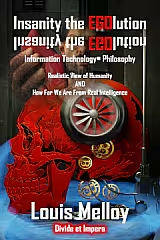
The world has fallen apart—but not just now. Since the dawn of human evolution, we have taken intellectual paths hat we could have corrected. The pursuit of pleasure, greed, and power began to gain the upper hand at some point—especially a few thousand years ago. How all of this began and why too little humanity and too many lies will ultimately wipe us out in a process of entropy is obvious and is rooted, above all, in the mental illnesses that have developed as a result. The emergence of barriers such as religion, language, ethnic origin, but above all material wealth, must be recognized and overcome. How did witch burnings and the defamation of groups such as the Jews come about? Why do banking systems and digital tools such as artificial intelligence and digital currency exist? Who is or was Satoshi Nakamoto, Shabbatai Zvi, Jacob Joseph Frank, and Joseph, the King of the Khazars? Why are we becoming increasingly stupid, and what does the Internet have to do with it? How did media such as newspapers and television come into being? What is wrong with the data available globally, and why does it contribute to our destruction? Why not all Jews are the same and what the umerians have to do with it. If inventions such as data processing, the Internet, and computer technology serve solely to record human habits, desires, and secrets, then data must be protected and monopolies prevented. Over the course of millennia, our drive for innovation has shifted from technical innovations designed to make life easier to tools purely for power and manipulation; the result, among other things, is pathological selfishness and narcissism, as well as an addiction to pleasure and power. Embark on an extraordinary journey that you won’t find in any history book—or even on the Internet!
Release date of the english version 01.10.2026. Available at Wortundgeistreich, artdesign88 and over my own website. The number of pages has not yet been finalized. Reading sample follow.
Louis Melloy is a passionate IT expert. In school, he was particularly fascinated by math, chemistry, and physics. After graduating from high school, he joined the Navy and tracked (enemy) activity on radar. Since 1996, he has worked as a project manager and security consultant in many areas of business, among other roles. He quickly realized that there were serious problems with data processing, people, and the underlying processes. This ultimately inspired him to write so that others could benefit from his knowledge.
How the “First State” has enabled international crime, sheltered tax dodgers, and diverted hard-earned dollars from the rest of us
The legal home to over a million companies, Delaware has more registered businesses than residents. Why do virtually all of the biggest corporations in the United States register there? Why do so many small companies choose to set up in Delaware rather than their home states? Why do wealthy individuals form multiple layers of private companies in the state? This book reveals how a systematic enterprise lies behind the business-friendly corporate veneer, one that has kept the state afloat financially by diverting public funds away from some of the poorest people in the United States and supporting dictators and criminals across the world.
Hal Weitzman shows how the de facto capital of corporate America has provided safe haven to money launderers, kleptocratic foreign rulers, and human traffickers, and facilitated tax dodging and money laundering by multinational companies and international gangsters. Revenues from Delaware's business-formation industry, known as the Franchise, account for two-fifths of the state’s budget and have helped to keep the tax burden on its residents among the lowest in the United States. Delaware derives enormous political clout from the Franchise, effectively writing the corporate code for the entire country―and because of its outsized influence on corporate America, the second smallest state in the United States also writes the rules for much of the world.
What's the Matter with Delaware? shows how, in Joe Biden’s home state, the corporate laws get written behind closed doors, enabling the rich and powerful to do business in the shadows.
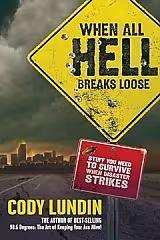
The birth of the book! With the success of my first book, 98.6 Degrees: The Art of Keeping Your Ass Alive, I was commissioned by my publisher to write a book on urban survival in June of 2004. They initially wanted to use 98.6 as a framework for the new book, and even offered to help write it (cringe). Of course I refused. Nearly a year passed before more dialog happened with my publisher regarding the project. Over the months, I had grown even more disgusted with what was happening to my country, and how “fear” seemed to hold sway over the masses. I knew I could offer people an alternative to fear, vulnerability and powerlessness, and it was this knowingness that led me to want to pursue the project. After months of contract wrangling and negotiations, I started to write When All Hell Breaks Loose sometime in late 2005.
My contract paid me to write a 200 page book. However, even though I tried to keep it simple, the more I delved into the realities of what an urban calamity might entail, the more the book gained page length. My publisher gave me the green light to proceed and then the real work started. I received three extensions on my contract deadline that ultimately ended up being nearly six months over-due. The last several months of the project were grueling and consisted of six day work weeks writing 11 hours a day. Everything else was put on hold.
When the book was finally released, When All Hell Breaks Loose sold out its first printing of 10,000 books in less than three weeks. It’s regularly listed in Amazon’s top five sellers under the “Disaster Relief” and "Survival Skills" headings, is in its seventh printing, and is still selling strong. Thanks to everyone for continuing to make the book a success!
Urbanely Yours, Cody Lundin
Survival expert Cody Lundin's book is what every family needs to prepare and educate themselves about survival psychology and the skills necessary to negotiate a disaster.
This is not your father's scout manual or a sterile FEMA handout. It entertains as it informs, describing how to maximize a survival mind-set necessary for self-reliance. According to the book, living through an emergency scenario is 90 percent psychology, and 10 percent methodology and gear. Relevant quotes and tips are placed throughout the pages to help readers remember important survival strategies while under stress and anxiety.
Lundin also addresses basic first aid and hygiene skills and makes recommendations for survival kit items for the home, office, and car.
Watch naturalist Cody Lundin in "Dual Survival" on The Discovery Channel as he uses many of the same skills and techniques taught in his books.
When All Hell Breaks Loose provides solutions on how to survive a catastrophe. Lundin addresses topics such as:
* Potable drinking water * Storing super-nutritious foods * Heating or cooling without conventional power * How to create alternative lighting options * Building a makeshift toilet & composting the results * Catching rodents for food * Safely disposing of a corpse
The birth of the book! Nearly ten years before the publication of 98.6 Degrees in 2003, I had been thinking about writing a book about outdoor survival skills. I wanted to do something "different" in the survival book genre and focus exclusively upon the issues facing the vast majority of modern outdoor enthusiasts, and why many of them came home dead. I knew I would experience fallout from some readers and survival instructors alike who were enslaved by out dated, mind numbing concepts of what a modern survival book should contain. These misconceptions had been indoctrinated and perpetuated since time began by old military survival manuals that while cool, were geared for combat and “living off the land,” not surviving a day hike gone bad and dealing with hypo and hyperthermia--statistically the biggest killers of all outdoor travellers. I also knew that I wanted to go with a real publisher. Self-publishing seemed like an endless, self-marketing journey, complete with sagging leaf springs from a vehicle overloaded with poorly photocopied “books” held together with staples. Worse yet, I had to pay someone to print them!
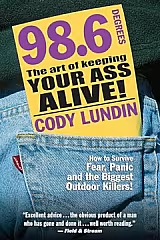
Survival expert Cody Lundin shares practical wilderness wisdom for maintaining your core temperature at 98.6°—the ultimate guide to staying alive whether you're in the backcountry, backyard, or stranded on highways.
In his entertaining and informative style, Cody stresses that a human can live without food for weeks and without water for about three days or so. But if the body's core temperature dips much below or above the 98.6 degree mark, a person can literally die within hours. It is a concept that many don't take seriously or even consider, but knowing what to do to maintain a safe core temperature when lost in a blizzard or in the desert could save your life. Lundin delivers the message with wit, rebellious humor, and plenty of backcountry expertise.
Watch naturalist Cody Lundin on "Dual Survival" as he uses many of the same skills and techniques taught in his book: 98.6 Degrees: The Art of Keeping Your Ass Alive.
CODY LUNDIN is an internationally recognized professional survival instructor with more than 34 years of hands-on teaching experience. Unbeknownst to him at the time, Cody's love of all things self-reliant began as a child with the influence of his homesteading grandparents. Their rural South Dakota lifestyle of living close to the land and doing more with less was Cody’s first exposure to what the family still calls, “that good ol’ pioneer spirit.”
The only child of a military family, Cody moved frequently, including time spent in Europe. During these years of migration, with no formal base to call home, Nature became Cody’s constant companion, whether in the neighboring woods or the back yard.
During his teenage years in the prairies and mountains of Wyoming his interest in self-reliance training continued. He would frequently hike alone into the Wyoming wilderness with spartan gear and a piece of fishing line to improvise catching brook trout. Cody graduated early from high school, created his first survival kit for living on the road, and boarded a westward bound greyhound bus with a duffle bag and a guitar – making raw choices that would nearly cost him his life. He lived on city streets, alone in the woods, in a radical commune a few miles from the Mexican border, and generally immersed himself in the dark years he simply calls, “my warrior training.”
Cody’s life changed forever when he experienced a transformation in the red rock wilderness of Arizona. This profound experience with the natural world inspired him to change his life and share Nature with others. He then consciously entered a multi-year journey of hard choices, deprivation and self-correction.
Cody's famous feetIn 1991, with an initial investment of less than $10, Cody founded the Aboriginal Living Skills School using the same passion, determination and psychological stamina he used to overcome personal challenges and heal his life.
Cody wrote, produced, directed and starred in The Survival Show with Cody Lundin, the only survival show created by a real survival instructor. He is also the best-selling author of two books on survival and preparedness, 98.6 Degrees: The Art of Keeping Your Ass Alive (2003) and When All Hell Breaks Loose: Stuff You Need to Survive When Disaster Strikes (2006). Both books have been translated into several languages and are routinely featured in the top ten best-sellers for their genre on Amazon. His expertise in practical outdoor skills comes from a lifetime of personal experience including two years spent living in a brush shelter in the woods where he slept on pine needles and cooked over an open fire.
Our Own Worst Enemy: The Assault from within on Modern Democracy
A contrarian yet highly engaging account of the spread of illiberal and anti-democratic sentiment throughout our culture that places responsibility on the citizens themselves.
Over the past three decades, citizens of democracies who claim to value freedom, tolerance, and the rule of law have increasingly embraced illiberal politicians and platforms. Democracy is in trouble--but who is really to blame?
In Our Own Worst Enemy, Tom Nichols challenges the current depictions of the rise of illiberal and anti-democratic movements in the United States and elsewhere as the result of the deprivations of globalization or the malign decisions of elites. Rather, he places the blame for the rise of illiberalism on the people themselves. Nichols traces the illiberalism of the 21st century to the growth of unchecked narcissism, rising standards of living, global peace, and a resistance to change. Ordinary citizens, laden with grievances, have joined forces with political entrepreneurs who thrive on the creation of rage rather than on the encouragement of civic virtue and democratic cooperation. While it will be difficult, Nichols argues that we need to defend democracy by resurrecting the virtues of altruism, compromise, stoicism, and cooperation--and by recognizing how good we've actually had it in the modern world.
Trenchant, contrarian, and highly engaging, Our Own Worst Enemy reframes the debate about how democracies have ended up in this dire state of affairs and what to do about it.
Tom Nichols is a staff writer at The Atlantic. He was a professor of national security affairs for 25 years at the U.S. Naval War College, and is the author of The Death of Expertise (Oxford 2017) as well as books on Russia, the Cold War, nuclear weapons, and the future of armed conflict. He was also an instructor at the Harvard Extension School and an adjunct professor at the US Air Force School of Strategic Force Studies. He is a former aide in the U.S. Senate and has been a Fellow of the Kennedy School of Government at Harvard University.
He was also a Senior Associate of the Carnegie Council on Ethics and International Affairs in New York City, a Fellow of the International History Institute at Boston University, and a Senior Fellow of the Graham Center for Contemporary International History at the University of Toronto. Previously he was a Fellow at the Center for Strategic and International Studies in Washington, DC.
In 2017 Tom was named one of POLITICO Magazine's "POLITICO 50," the thinkers whose ideas are shaking up American politics and public life.
Tom is also a five-time undefeated Jeopardy! champion. He played in the 1994 Tournament of Champions, is listed in the Jeopardy! Hall of Fame, and as one of the game's top players was invited to participate in the 2005 Ultimate Tournament of Champions, where he played his final match.
Artificial intelligence – breeding ground for copyright infringements. Mathematics as a universal helper, packed in bits and bytes. Simple numbers, as states of tension, are capable of creating billionaires and people hacked at the same time. Unsuspecting and believing that they will receive free online services, the masses give away everything they have, namely their independence, their thoughts, their belongings. Above all, however, their own future and that of their fellow human beings. The ignorant must be made into knowers, if only to balance the yin and yang. The habit of imitating others turns many things into a uniform mush and destroys individuality. Such behavior makes it impossible at a certain point to maintain or maintain human social contacts. But this is exactly what some want! If artificial intelligence is preferred to human interaction, certain circles see a weak point into which they can stab. Cryptocurrencies, Internet of Bodies, consciousness sciences, and exploring suffering and feelings is not something that should be left to artificial intelligence. If data is collected over decades and then serves as a training basis for AI, regardless of existing data protection laws, there will once again be educational work for certain professions and our privacy will continue to suffer. Creative professions depending on language, painting, writing and education as well as in social areas will sooner or later be replaced by AI. Why this only makes sense for a few, but not for the general public, can be found here. Learn why online services make you unemployed sooner rather than later, turning generations into useless bodies. What increases one mans power and bank account is another mans downfall. The very fact of establishing rules for others that apply to everyone except those who issue them testifies to inferior thinking, which at best serves only individuals, but not humanity, which needs to be developed.
I wrote years earlier about the impact of AI on the labor market. Since the emergence of social media, Google and Amazon, I have been warning about data theft, long before anyone else did!
Great explanation about Artificial Intelligence with huge amount of examples, of what you should do and better not. For me it`s a special kind of paperwork. It comes very soon, where noone wrote before warnings like that. Louis Melloy wrote also about topics, I dont see in another guide.